
Case Study
From Buried NERIS/NFIRS Reports to Defensible Answers in Seconds
How Vallejo Fire Department piloted Fireline Intelligence to turn NERIS/NFIRS narratives and RMS exports into a searchable, audit-ready system of record.
Product
Fireline Intelligence
Agency
Vallejo Fire Department (pilot evaluation)
Contributor
Aaron Klauber, Firefighter, Data Analyst, Consultant
Focus
Incident Analytics, PRA & Grant Support
~2 min
Call volume analysis
Mare Island call counts that previously took hours of CSV sorting now surface in roughly two minutes.
80%
Less administrative time
Reduction in administrative time on data-intensive pilot tasks like grant pulls and PRA responses.
100%
Searchable narratives
Every recent incident narrative in the pilot dataset is now searchable and auditable, not just coded fields.
Background
A Department Rich in Data, Starved for Insight
Vallejo Fire Department runs approximately 16,000 calls per year. Like most agencies, they capture detailed incident data such as apparatus times, locations, call types, and officer-written narratives in their records management system. Turning that raw data into defensible intelligence for command staff, grant applications, Public Records Act (PRA) responses, and city council presentations has always required significant manual effort.
As both a firefighter and the department's de facto data analyst, Aaron Klauber handles everything from PRA requests to grant data pulls and standards-of-cover support. He has felt firsthand how long it takes to turn raw incident data into something leadership can act on.
The Challenge
Hours of Grunt Work. Weeks of Exposure.
When a fire chief, city council member, or external auditor needs data, the process has historically been the same: export a CSV, sort through thousands of rows, cross-reference narratives manually, and build a report from scratch. A routine data request could consume two to three hours. A complex one, such as a multi-year grant justification or a PRA response, could span two to three days of focused work.
“Fire chief asked me just the other day: how many calls have we had in the last year on Mare Island? Traditionally I have to go into ImageTrend, sort all the calls, and if the zip codes are wrong I have to match versus the addresses, and I cannot even plot it on a map.”
Aaron Klauber, Firefighter and Data Analyst
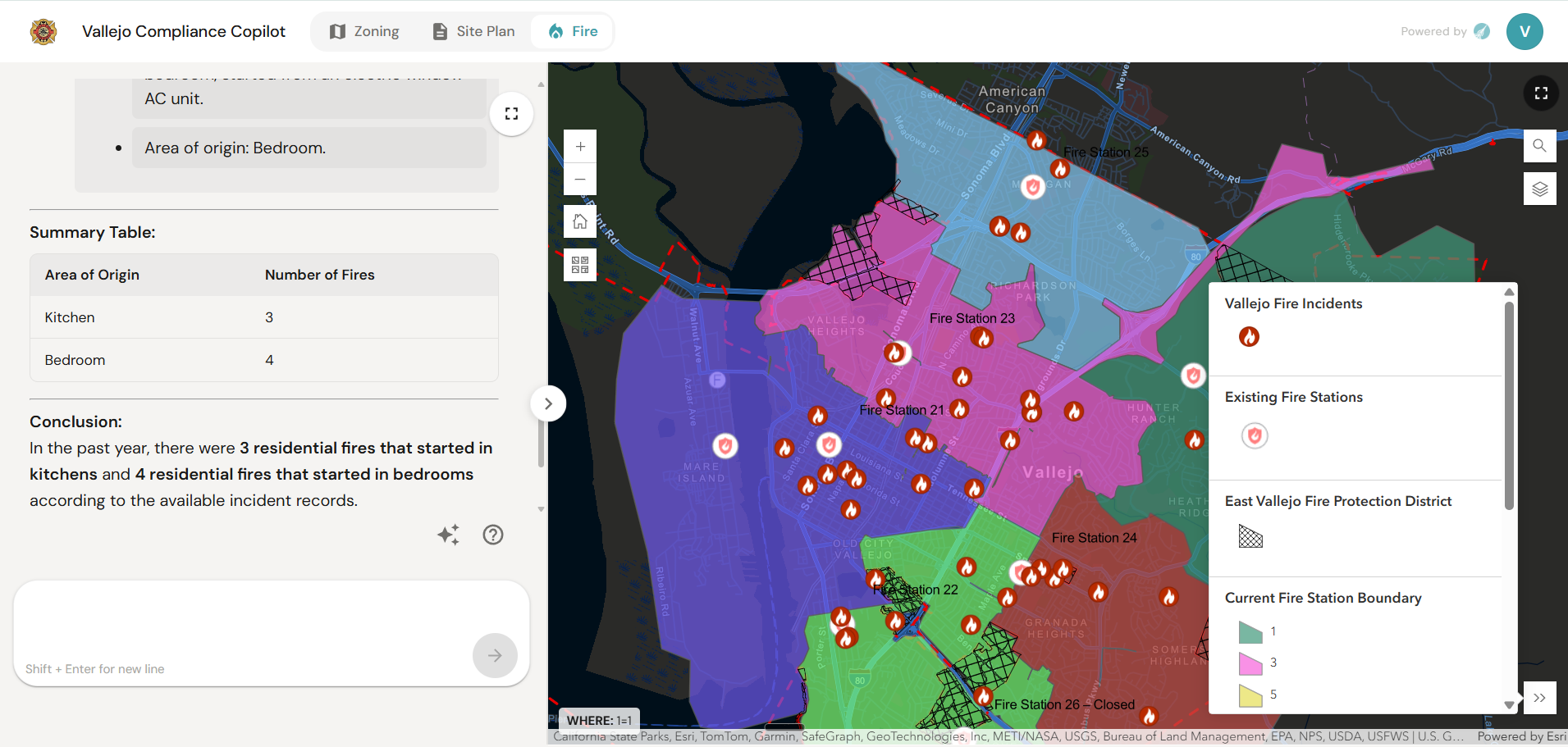
The deepest problem was the narratives. Critical details such as causal factors, room of origin, property type, and encampment involvement lived in free-text fields that existing tools could not search or analyze at scale. If Vallejo or neighboring agencies needed to understand how many structure fires involved homeless encampments, or how many kitchen fires versus bedroom fires, someone had to read every report manually.
For grant writing, PRA responses, standards-of-cover documentation, and potential litigation, this was more than inefficient. It was a liability. Defensible data requires an audit trail. Spreadsheets and manual lookups do not provide one.
The Pilot
Fireline Intelligence on Real Incident Data
To test what was possible, Conflation Labs ran limited pilots of Fireline Intelligence with Aaron on real NERIS/NFIRS and RMS export data, starting with Vallejo and extending to a neighboring city's incident history. The pilots used existing reporting exports only: no CAD integration, no new data collection, and minimal IT lift required to get started. Within weeks, Aaron had working environments where the system could read both coded incident data and free-text narratives as a single, unified source of operational intelligence.
The interaction is conversational. Aaron types a question in plain English, such as “What is the date range for this dataset?”, “How many structure fires did we have in this time period?”, or “What is the average response time to medical calls, and which days have the most late calls?” The system responds with structured answers that are always traceable back to incident numbers. When he wants to go deeper, he just asks the next question.
“I want the number of calls on the island. Cool. But then I can say: what is the average response time from those calls? And from there: what are the outliers? I can start digging even deeper and start answering my own questions in 20 to 30 minutes rather than spending two or three days on one of these projects.”
Aaron Klauber
Under the hood, Fireline Intelligence parses both structured fields and free-text narratives, understands fire-service terminology and apparatus names, and returns results that line up with how analysts already work. It automatically applies the rules people like Aaron already use: distinguishing Code 3 from Code 2 responses, flagging canceled-en-route calls so they can be excluded from response-time and UHU metrics, and calling out missing or inconsistent time data instead of silently ignoring it.
Because Fireline Intelligence reads officer-written field notes alongside NERIS/NFIRS codes, it can do what spreadsheets and RMS filters cannot. It identifies structure fires where the Fire or Property module was never filed, confirms ambulance transport from narrative even when no medic unit is listed in the apparatus section, and infers district coverage, such as a district defined by a cluster of streets, from repeated address patterns. It understands operational context the way an experienced analyst does, but at the scale of an entire incident history.
“Nothing reads narratives. If you want to analyze the last 20 structure fires, you have to go print all 20 NFIRS reports and manually read them. Now you have a system that can read them. And for officers who misspell things, it can make inferences. A standard search function in ImageTrend or any of these other programs cannot do that.”
Aaron Klauber
The Product
Fireline Intelligence in action
Pilot Results
Real Queries. Real Time Saved. Real Operational Insight.
Aaron put Fireline Intelligence through the same questions command staff actually ask, across both Vallejo and a neighboring agency's data. Here is what he was able to do.
Mare Island Call Volume Analysis
A request that previously required sorting ImageTrend exports, reconciling zip code mismatches against addresses, and building a manual tally was answered in roughly two minutes. Every statistic was traceable back to specific incident IDs, making the result immediately defensible in a city-level resource conversation.
Ambulance Response Time Audit
Aaron ran a full call-time audit on one pilot dataset and discovered roughly 60% of on-scene times were missing from records. This was an operational blind spot that had never been visible at scale. Within hours, the finding was escalated to the paramedic coordinator, triggering a documentation-process change discussion inside the department.
Structure Fire Breakdown
Fireline Intelligence produced a residential-versus-commercial structure fire breakdown by pulling from coded fields and narrative text simultaneously. Spot-checks against the underlying NERIS/NFIRS reports matched, giving command staff confidence that AI-derived summaries align with their official records.
Homeless Encampment Fire Analysis
A query type that is impossible with structured data alone: pulling incidents where narrative text, not just coded fields, referenced fires at homeless encampments. The system read every narrative and returned incident IDs with summarized field accounts, enabling trend analysis for community risk reduction. Similar narrative-driven searches can pull kitchen fires for public-education campaigns or surface sober-living-facility calls that never had specific dispatch codes.
Data Quality Discovery
By querying response times systematically, Fireline Intelligence helped Aaron identify patterns of incomplete documentation that had never been visible at scale. Outliers and gaps were highlighted without being silently dropped. This preserved defensibility while giving analysts the context to investigate and clean data before it enters a report.
Real-Time Style Command Questions
Instead of drafting a request and waiting days for a data pull, chief officers participating in the pilots saw how questions like “Show me ambulance response times for the last week” or “Show me medical calls in District 7 in the last quarter” could be answered in seconds. A recurring multi-hour reporting cycle became an on-demand interaction.
Medical Response Time Performance
Using existing NERIS/NFIRS and RMS timestamps, Fireline Intelligence calculated average alarm-to-arrival times, compared them against the 6:59 (419-second) standard, and highlighted the days and hours with the highest share of late calls. It surfaced concrete examples of calls over the threshold and tied them to likely causes such as overlapping incidents, staging for safety, or units coming from another call. Leadership could see not just where they were missing the mark, but why.
Clean, Standards-Aligned Metrics
When Aaron narrowed the scope to only calls that count toward the 6:59 standard, Fireline Intelligence automatically excluded lift assists and Code 2 responses based on incident priority and narrative context. That left a clean set of true Code 3 medicals for compliance reporting, instead of a blended dataset that understated performance and muddied conversations with council or accreditation reviewers.
Unit Hour Utilization Without Spreadsheets
Fireline Intelligence calculated monthly Unit Hour Utilization for frontline engines using only existing incident timestamps. It summed dispatch-to-clear intervals for each apparatus, excluded canceled-en-route calls and incomplete records, and produced quarterly UHU percentages within close range of an analyst-built Excel model, without assigning someone days of spreadsheet work.
In Aaron's Words
Why This Tool Stands Apart
“Fire departments already have the data they need to improve performance, it is just buried in narratives and systems that are not built for analysis. Fireline Intelligence changes that by making this information accessible and defensible, allowing agencies to identify trends, answer PRA and grant questions quickly, and support both day-to-day and strategic decision making.”
“Fire departments generate an enormous amount of operational data, but much of it remains underutilized. Tools like Fireline Intelligence help bridge that gap by making narrative and incident data searchable, structured, and actionable. That allows agencies to move beyond reporting and start using their data to drive real operational and strategic decisions.”
Aaron also noted something that often surprises department leadership: the tool does not replace experienced staff. It makes them more powerful. Knowing what to ask is still the job. The platform simply removes the friction between question and answer.
“We are not asking it to make analytical decisions and interpretations. We are asking it to parse the data, which is what AI is really good at. We do not need it to tell us why the fire started. We need it to surface what is already in the records, fast.”
Aaron Klauber
Looking Ahead
From Pilot Analysis to Department Intelligence
Aaron's pilot work points to a larger shift in how fire agencies can operate. When data retrieval drops from hours to seconds, command staff stop waiting for reports and start imagining what real-time monitoring could look like. Grant applications become faster and more defensible. PRA responses that once required weeks can be assembled in minutes. The narratives that officers write in the field, previously too voluminous to analyze, become a searchable institutional memory.
Conflation Labs is actively expanding Fireline Intelligence to include automated dashboards, voice-based querying for field personnel, and deeper GIS integration that maps incident patterns alongside stations, first-due areas, and coverage zones. Departments can start where Aaron did, with a simple RMS export pilot, and grow into dashboards, GIS overlays, and voice interfaces as internal capacity and IT comfort increase.
For departments looking to do more with the data they already have, without new IT infrastructure or new data collection burdens, the path forward starts with making what exists actually usable. That means turning the same NERIS/NFIRS and RMS exports already used for PRA responses and grant attachments into a living, searchable system of record, where every chart and KPI is backed by incident numbers, narratives, and an audit trail the city attorney and council can trust.

About the Contributor
Klauber and Associates
Klauber and Associates provides specialized consulting services focused on the intersection of fire-service operations, data analysis, and public-safety technology. They support fire departments, municipalities, and technology partners in transforming operational data into clear, actionable intelligence that improves decision making, efficiency, and service delivery.
Ready to Make Your NERIS/NFIRS Data Actually Usable?
See how Fireline Intelligence can turn your existing exports into searchable, defensible operational intelligence, without new infrastructure or new data collection.