
Document Intelligence/Enterprise Search
Ask Your Documents. Get Cited Answers.
It reads the codes, plans, packets, contracts, and budgets your team already has, and answers questions in plain language. Every answer points to the exact page it came from.
What conditions did the city put on the 1994 Harbor Street variance?
Match found
Scanned paper and digital
1994
1998
2002
2006
2010
2014
2018
2022
2026
Resolution 94-117, p. 3
What It Reads
Every Document Your City Produces
Upload once, instantly searchable through conversation.
Council & Commission Packets
Agendas, staff reports, attachments from Granicus, Legistar, eSCRIBE
Ordinances & Municipal Code
Municode, AmLegal, or PDFs hosted on the city site
Resolutions & Policy Registers
Fee schedules, policy decisions, approvals from clerk's records
RFPs, RFQs & Contracts
Procurement/finance systems and shared drives including proposals received
General Plans & Zoning Maps
Comprehensive/specific plans plus land-use layers from planning's document center
Permits & Entitlement Records
Building/planning permits, inspections, conditions of approval
Business Licensing & Incentives
License fees, incentive programs, and how to start a business, answered the way City Hall would at the counter
Budget, CIP & Financial Statements
Adopted budgets, CAFR/ACFR, capital project lists from finance repositories
Departmental Document Repositories
OneDrive/SharePoint folders for planning, public works, ED, city manager
Spreadsheets & CSV Data
Budgets, property lists, permit data, inventory: ask for the numbers directly
Live Web Pages
City websites and planning portals, kept up to date automatically
How It Works
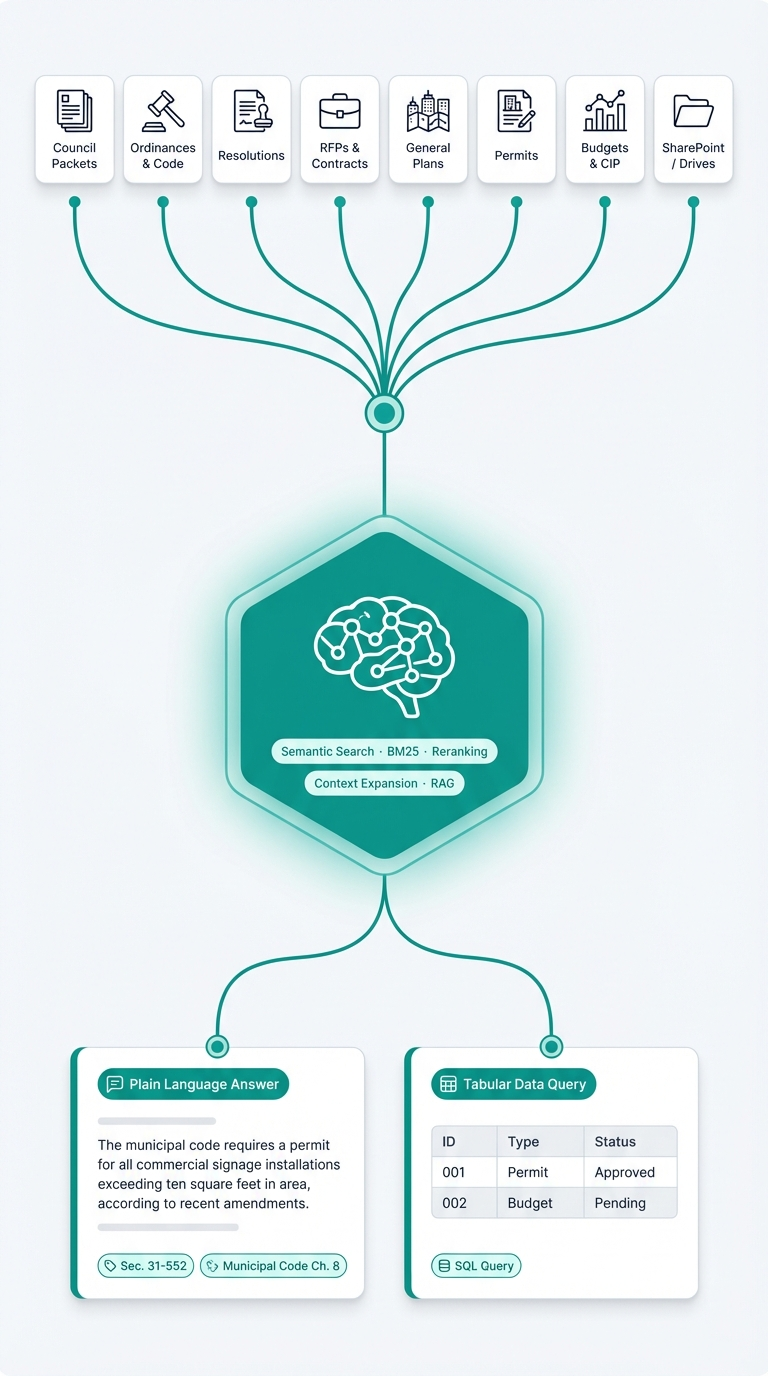
From your documents to a cited answer
Connect the documents your team already keeps. Anyone can then ask a question in plain words and get a clear answer, with the page it came from.
Connects to the documents your city already produces
Understands the question, even when the wording differs from the document
Answers in plain language and works with spreadsheets too
Why Teams Trust the Answers
Built From Your Own Record
Answers come from the documents your organization has adopted and filed, and every one of them can be checked.
Only your documents
Codes, plans, packets, contracts, and spreadsheets your organization already keeps. Answers never draw on outside sources.
Cited to the page
Every answer names the document, section, and page it came from, so the answer holds up in a council meeting or a public records request.
Private to your team
Your documents are used to answer your questions. They are not used to train public AI models.
Key Benefits
What Makes It Different
Every Answer Cited
Each answer points to the document, section, and page it came from, so anyone on your team can check it in one click.
Reads the Actual Ordinance
It reads the full zoning code, not a simplified FAQ. When it cites 'Sec. 31-605(a)(1)', that text came straight from your document.
Conversation Context
Ask a follow-up and it remembers what you asked before. No need to re-explain the situation with every message.
Handles Tables & CSV Data
Upload a property inventory spreadsheet and ask 'How many ADU permits were issued last year?' You get the number, worked out from your own data.
City-Specific, Always
Berkeley's rules aren't mixed with Riviera Beach's. Each city has its own set of documents, so every answer comes from that city's actual record.
Upload → Instantly Live
An admin adds a new ordinance the day it passes, and your team can ask about it within minutes.
Real-World Scenarios
Questions It Answers in Seconds
“How does the City sell surplus real estate?”
“What permits do I need to build an ADU?”
“Can I sell hot food on the street?”
“What's the minimum front setback in a residential zone?”
“What are the operating hours restrictions for outdoor dining?”
“What signage spacing is required for electric fences?”
“How many commercial parcels are over 10,000 sq ft?”
“What are the water conservation rules for landscaping?”
Who Benefits
One agent. Every audience.
| Audience | What They Get |
|---|---|
| City Planning Staff | Answer citizen and developer questions instantly: consistent, policy-correct, sourced. Reduce inbound emails on repetitive zoning questions. |
| Developers & Property Owners | Self-serve 24/7. Understand requirements before spending money on architects or permit applications. |
| Architects & Consultants | Cross-reference building codes and zoning rules for any city in one place, without digging through 300-page PDFs. |
| Citizens / General Public | Ask questions in plain English, get plain English answers. 24/7 access, not limited to counter hours. |
| City Leadership | Every answer is grounded in actual policy documents. Source citations mean answers are auditable and defensible. |
Impact
Consistent, cited answers, available the moment a new document is uploaded.
Planner Response Time
Days
→
Seconds
Inbound Repetitive Calls
High Volume
→
Self-Serve
New Ordinance Go-Live
Weeks of setup
→
Upload → Live
Give the Public 24/7 Access to Policy Answers
Grounded in your actual documents. Not AI guesswork. Every answer cited to the source.