
Zoning and municipal planning insights
Join our early access program and receive free access →
Join our early access program and receive free access →
Back to Blogs

BiGyan
August 10, 2026
7 min read

Almost everyone in real estate ends up asking the same question, over and over, on a rolling basis: what can actually be built here?
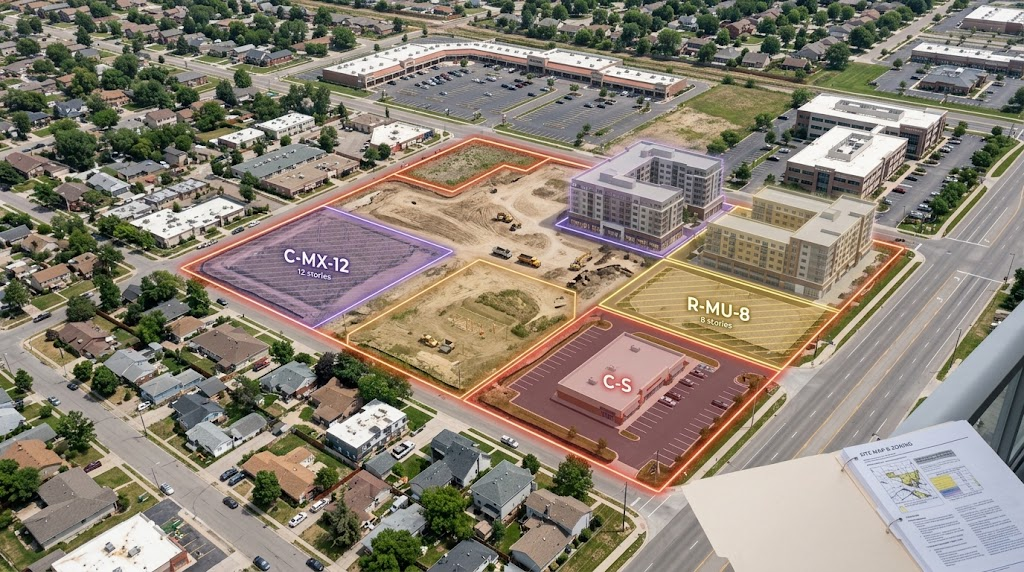
Developers ask it before they option a site. Brokers ask it before they tell a client a deal pencils. Investors ask it before they make an offer. Builders ask it before they commit crews and capital. It doesn't matter what market you're in or what the job title says, the question, and the pain of answering it, is the same from coast to coast.
And the honest answer almost always requires digging through a zoning ordinance that wasn't written to be read quickly, by someone who isn't a planner. That's where zoning AI for real estate can make a difference: helping professionals get from a parcel to a practical zoning answer without manually working through an ordinance every time.
Whether the deal is a ground-up commercial build, a subdivision play, or a straightforward acquisition, the research process tends to look the same:
Multiply that by the volume a busy professional works through in a month, and the research alone becomes a part-time job. It isn't usually finding sites that's the bottleneck, it's burning too much time confirming whether a site is even usable before committing time, capital, or a client's trust to it.
That's why AI zoning for real estate is becoming an increasingly useful part of the initial screening process: not to replace due diligence, but to make the first pass through zoning information faster.
A few things make parcel-level zoning research genuinely difficult, no matter which side of the real estate business you sit on:
Rural and secondary markets are underserved by data infrastructure, and this holds true in every region of the country. A lot of real estate activity, subdivision deals, secondary-metro development, suburban infill, happens outside the handful of major metros with mature GIS systems. Whether you're working the Southeast, the Midwest, or anywhere else, big-city data coverage doesn't help if your deal flow is concentrated in the surrounding counties instead. For a zoning AI to be genuinely useful, its coverage needs to reflect where real estate professionals actually find opportunities.
Unzoned parcels are common, and most tools don't know what to do with them. In states with large amounts of unincorporated or unzoned land, a platform that only knows how to answer "what does the zoning code say" runs into a wall the moment there isn't a zoning code to reference. That's an important limitation for anyone relying on an AI zoning tool for real estate screening.
Utilities data remains an unsolved gap industry-wide. Zoning tells you what's legally allowed. It doesn't tell you whether water, sewer, or power actually reach the parcel, a separate and equally important piece of due diligence that almost no platform has integrated well.
Most existing platforms were built for institutional users, not the individuals and small teams doing the on-the-ground work. Enterprise zoning and land-data tools are often priced and designed around large teams running occasional deep analysis, not a broker, developer, or investor who needs to screen dozens or hundreds of properties a month, quickly, on their own. A useful zoning AI for real estate professionals needs to fit that faster, higher-volume workflow.
Talking to people doing this work every day, across investing, development, and brokerage, surfaces a fairly consistent list of requirements:
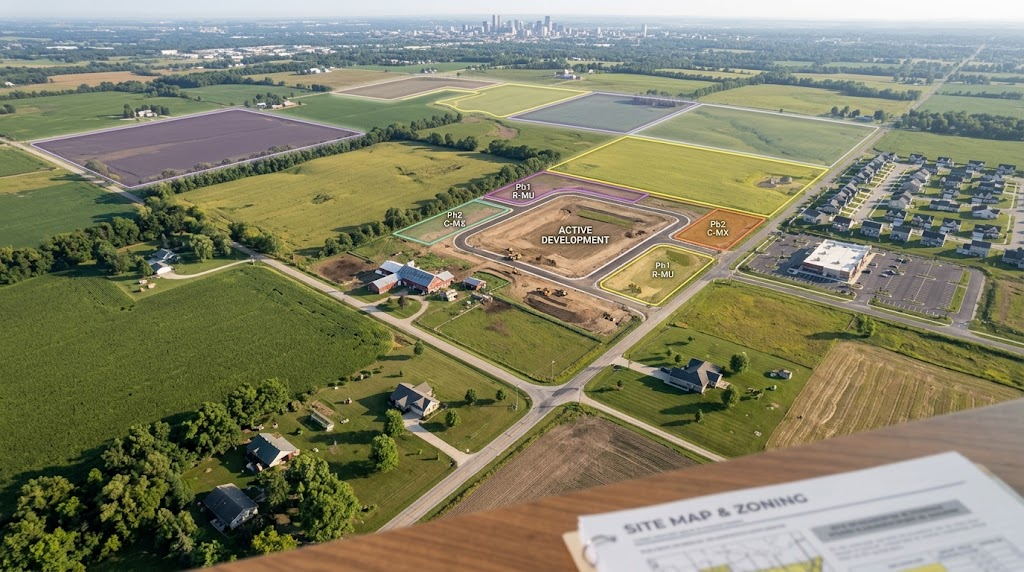
In other words, professionals don't just need another parcel zoning lookup. They need a tool that can help turn zoning data into an answer they can actually use when evaluating a property.
Professionals have also learned to be skeptical of platforms that expand coverage claims faster than their data can support. A tool that answers confidently but incorrectly for a county it doesn't actually cover well does more damage to trust than one that's simply honest about where it's strong and where it isn't. Many have tried platform after platform, only to move on the moment one gave them an answer they couldn't rely on.
For AI zoning in real estate, that reliability matters just as much as speed. A fast answer isn't useful if the underlying zoning information isn't trustworthy.
This is precisely the gap Conflation Labs is built to close: parcel-level zoning answers, grounded in the actual adopted ordinance, delivered conversationally, without requiring a developer, broker, or investor to become their own zoning analyst.
The mission is a straightforward one: give real estate professionals anywhere in the country a reliable, conversational way to answer "what can I build here?" without spending a part-time job's worth of hours on ordinance research. Getting there means building market by market rather than rushing a shallow nationwide footprint, so that when a county comes online, it's genuinely reliable rather than a rough first pass. For professionals whose deal flow spans multiple states and counties they can't predict in advance, that reliability matters more than a long list of covered jurisdictions that only sort of work.
If your research process still looks like downloading ordinances one county at a time and manually working through them, or feeding them into a general AI tool and hoping the answer is right, that's exactly the workflow a purpose-built zoning AI for real estate is designed to improve.
Conflation Labs is actively expanding coverage nationwide. Wherever you're working, get in touch and let us know your markets, we're prioritizing rollout around where real estate professionals actually need it.
If your day-to-day work involves researching parcels, reviewing zoning ordinances, or figuring out what can be built on a property, Conflation Labs can help. Our AI-powered zoning capabilities make it easier to find and understand parcel-level zoning information, so you can spend less time digging through ordinances and more time evaluating real estate opportunities.
Book a personalized demo to have our team walk through your zoning research workflow with you, or try the live demo to explore Conflation Labs on your own.