
Zoning and municipal planning insights
Join our early access program and receive free access →
Join our early access program and receive free access →
Back to Blogs

BiGyan
September 8, 2026
7 min read
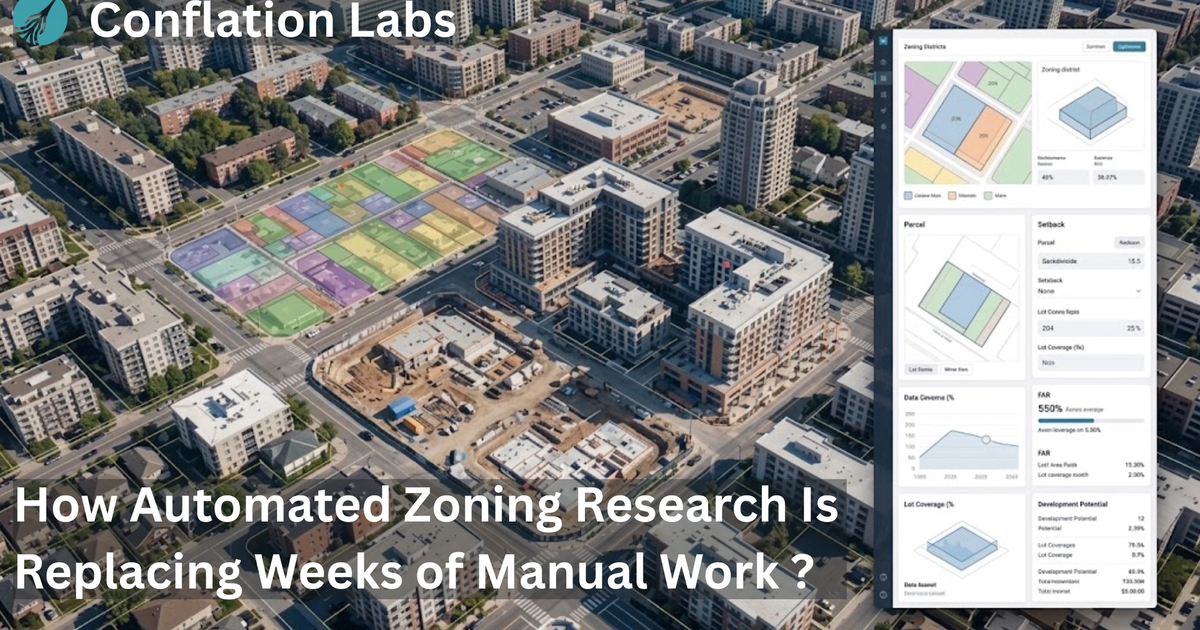
Every real estate deal starts with the same question: what can actually be built here?
Answering it has traditionally meant pulling municipal codes, cross-referencing GIS maps, and often waiting on a planning department or a paid consultant. AI zoning analysis exists to compress that process, from weeks down to seconds, by teaching software to read zoning codes the way a planner or land-use attorney does.
This guide covers what AI zoning analysis actually does, how automated zoning research tools work under the hood, where they still fall short, and what to look for if you're evaluating one.
AI zoning analysis uses machine learning and natural language processing to interpret zoning ordinances and calculate what a specific parcel legally allows, including permitted uses, height limits, setbacks, floor-area-ratio (FAR), lot coverage, and parking requirements, without a person manually reading the underlying code.
It's a step beyond a standard zoning map. A map tells you a parcel sits in an "R-2" or "C-1" district. An AI zoning analysis tool goes further and tells you what R-2 or C-1 actually permits on that specific lot, translating dense municipal language into a usable answer.
For real estate teams, this can turn zoning from a research bottleneck into an early-stage screening tool. Zoning AI for real estate explores how these capabilities can support site selection, development feasibility, and property research.
The core problem is fragmentation. The United States has more than 30,000 local jurisdictions, and each one writes, formats, and updates its own zoning code independently. There's no national standard, so "zoning research" means starting over for every new city.
That fragmentation shows up as real cost and delay:
This is part of a broader municipal workflow problem. As explored in How Long Does It Take to Answer a Zoning Question?, even seemingly straightforward zoning questions can require significant staff time when the answer depends on multiple documents, regulations, and parcel-specific conditions.
None of this is a knock on the people doing the work. It's a data-access problem: the information exists, it's just locked in inconsistent PDFs, ordinance text, and per-city portals that don't talk to each other.
Automated zoning analysis tools generally follow the same pipeline, even though implementations differ:
That last step matters more than it sounds. An automated zoning analysis tool that can't show its source ordinance language is asking you to trust a black box on a decision that can be worth millions of dollars.
This is also where AI differs from conventional planning technology. Traditional planning software may organize GIS data or help manage workflows, while newer AI systems can interpret unstructured zoning language and turn it into usable answers. For more on this distinction, see AI vs. Traditional Planning Software.
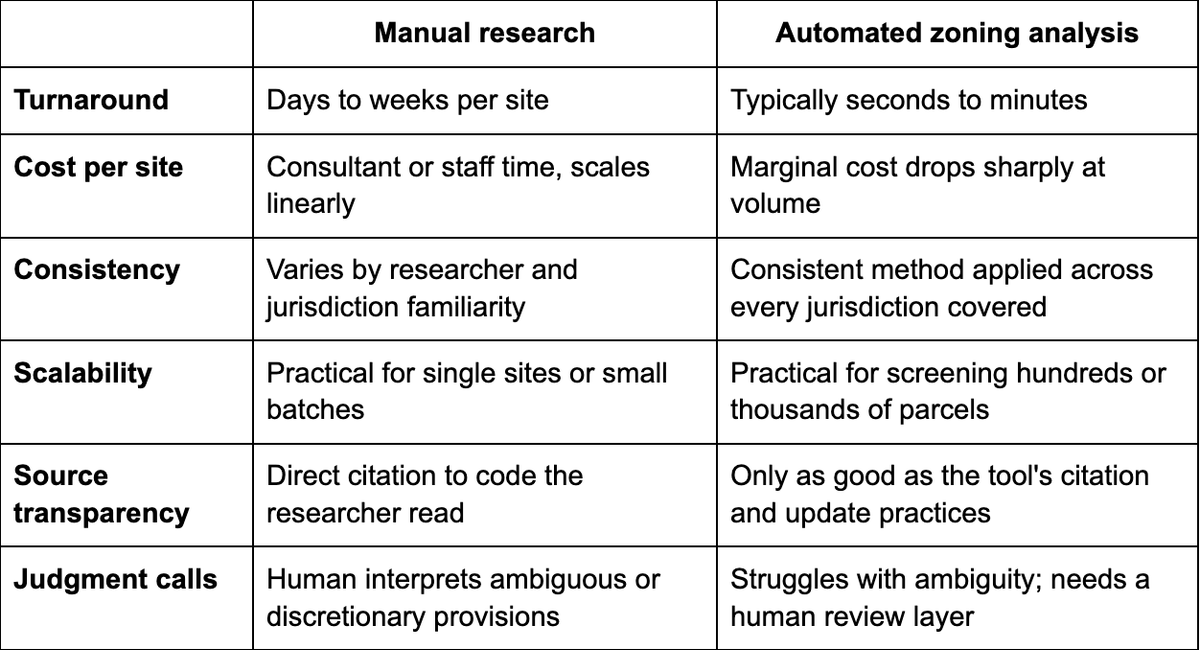
The realistic conclusion isn't "AI replaces the researcher." It's that automation handles the repetitive first pass, pulling the applicable standards, so the human's time goes toward judgment calls: variances, discretionary approvals, and edge cases the code doesn't answer cleanly.
Being direct about the limits matters, because overselling this category erodes trust with the exact audience that needs it most.
The practical takeaway: treat AI zoning analysis as the fast first pass that tells you where to point human expertise, not a replacement for it.
The same shift toward AI-assisted research is also happening across municipal planning workflows. How AI Is Transforming City Planning looks at the broader role AI can play in helping planning teams process information and respond to growing workloads.
If you're evaluating options, run through this checklist:
A good tool should make zoning research faster without making the underlying evidence harder to verify.
It should also fit into the larger development workflow. Zoning is rarely an isolated question. It can affect permitting, site feasibility, development timelines, and ultimately whether a project moves forward.
For a broader look at the development process, see Zoning Permits 101: Your Complete Guide to Navigating Municipal Development.
Zoning research has historically been a single checkpoint, something you look up once, early in a deal, and move past. Automation is starting to change that shape. Because a fast lookup can be repeated cheaply, teams are beginning to screen entire portfolios or entire submarkets for zoning changes and upzoning opportunities on an ongoing basis, rather than checking a single parcel once and considering the question closed.
That shift, from a one-time gate to continuous monitoring, is arguably the bigger long-term change than the speed gain on any single lookup.
If your team spends hours researching parcels, interpreting zoning ordinances, or determining what can be built on a property, Conflation Labs can help.
Conflation Labs brings AI-powered zoning analysis into the property research workflow, helping teams find parcel-level zoning information, interpret applicable regulations, and get to a defensible first answer faster.
Instead of starting every zoning question from scratch, your team can use AI to accelerate the research process while keeping the underlying sources available for verification.